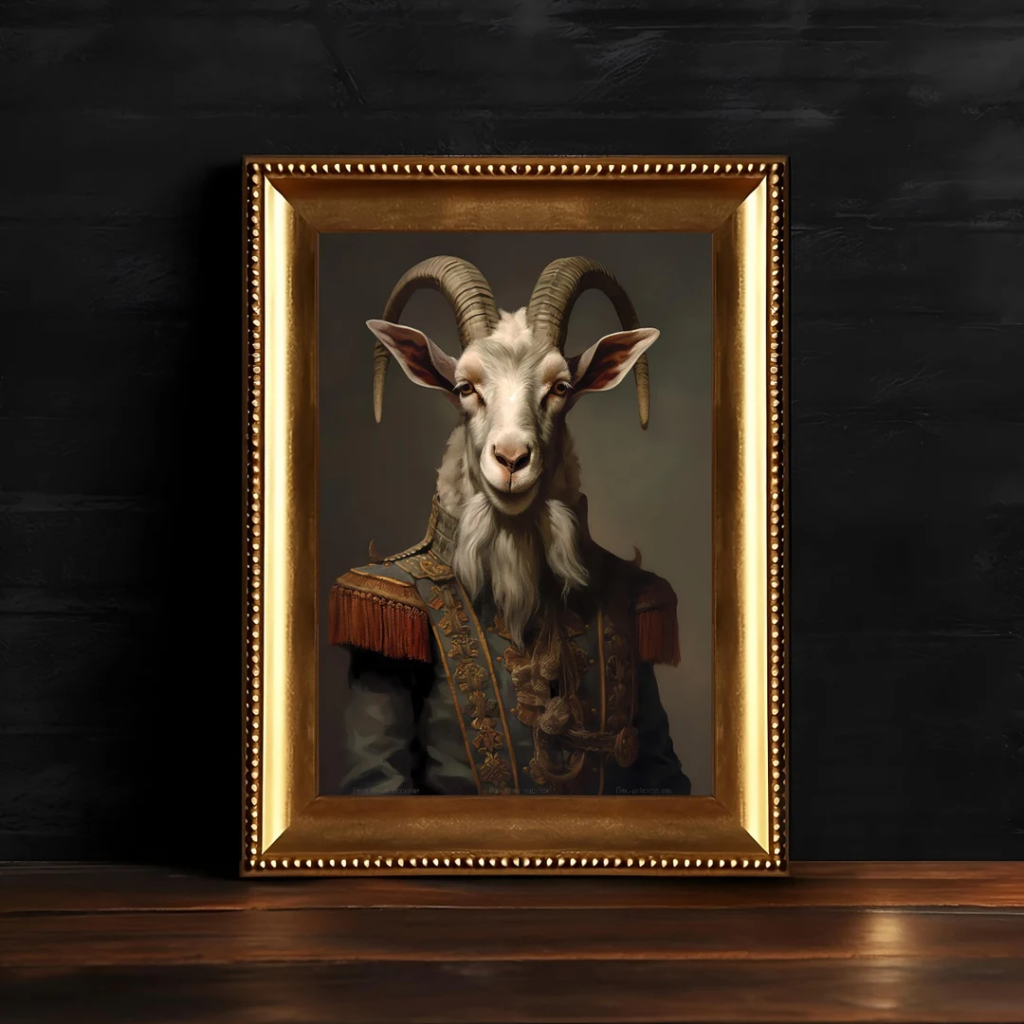
Documented Goats of the Schitt Family & Little Schitt’s Crossing
About the Register
The Caprine Register documents individually identifiable goats appearing in surviving Schitt family records, settlement documents, photographs, maps, ledgers, and associated archival materials.
Inclusion does not imply ownership. Early records demonstrate that the distinction between family goat, settlement goat, and goat merely present was not consistently observed.
Caprine Profile No. 001 — Ambassador
Associated with Bull Schitt
Registered Name: Ambassador
Species: Domestic goat
Family Association: Bull Schitt
Date of Birth: Not established
Date of Death: Not established
Present Whereabouts: Unconfirmed
Historical Classification: Notable Caprine Associate
A Goat of Uncertain Diplomatic Standing
Among the animals associated with the Schitt family, few possess a name quite as suggestive of importance as Ambassador.
Precisely what Ambassador represented, to whom he was accredited, and whether any other party recognized his authority remain unresolved questions.
His association with Bull Schitt is established within the family’s surviving narrative. Beyond that, the documentary record becomes considerably less cooperative. The Archives have encountered considerable curiosity regarding Ambassador’s whereabouts. Curiosity, unfortunately, is not evidence.
Nor does a distinguished name establish a distinguished career.
The Matter of His Disappearance
At various points, questions have arisen concerning what became of Ambassador. The Archives presently possess insufficient verified information to issue a definitive finding. No documented death has been established. No authenticated transfer of ownership has been produced. And no reliable account has yet reconciled the competing assumptions surrounding his absence. Accordingly, Ambassador shall not be classified as deceased, stolen, retired, promoted, or otherwise disposed of merely because somebody finds one explanation more entertaining than another.
Museum Finding: Ambassador remains a recognized caprine associate of the Schitt family whose ultimate disposition has not been established.
Curatorial Observation: It is perhaps fitting that a goat named Ambassador has managed to generate considerable discussion without leaving behind a single diplomatic communiqué.
The Archives remain willing to receive credible evidence. Statements beginning with “Everybody knows what happened to that goat” will be evaluated with appropriate caution.
Archival Status and Continuing Inquiry
Ambassador’s association with Bull Schitt is recognized in the surviving family narrative. His precise origins, accomplishments, and ultimate disposition remain matters of incomplete documentation.
The Archives have therefore retained his registration without assigning an unsupported birth date, death date, or final whereabouts.
Any subsequent evidence concerning Ambassador shall be examined for authenticity and entered into the Caprine Register as appropriate.
Registrar’s Observation: Ambassador appears to have achieved a distinction seldom granted to ordinary livestock: an official historical entry without having adequately explained himself.
Registration Status: Active archival record — historical particulars incomplete.
Caprine Register, Entry No. 001 — Crock O. Schitt Historical Archives
GOA-0314 — Sadie — IDENTIFIED
Family goat associated with Little Schitt’s Crossing. Individually identified in surviving family records
Documented in connection with the settlement plot map. Responsible for loss of the map’s lower corner. Damage consistent with chewing
Surviving map retained in the Archives
GOA-0002 Unidentified Founding Goat — UNCLAIMED
GOA-0319 “Adrift” — UNIDENTIFIED / FATE UNKNOWN
GOA-0052 Mill Pond Goat — UNCLAIMED / RECOVERED
GOA-XXXX — “Bender” — HUNTING GOAT / SOBRIETY VARIABLE
Frequently associated with Gultch’s Saloon after Dorcus began disposing of partially filled whiskey bottles behind the building in an effort to “civilize” the men. Remembered in family accounts as a capable field animal under appropriate circumstances.
“Bender was a good huntin’ goat when he was sober.”
GOA-XXXX — “Herman” — CROCK HERD / UNDECLARED
One of Crock’s seven goats, four of which he kept hidden while allowing only three to be routinely observed. Crock maintained that because everyone knew about only three goats and he was permitted four, he remained entitled to acquire another should he find one he liked. Herman was among the hidden four and is suspected of involvement in several of Crock’s mysteriously missing school assignments.
Archive Note: Crock has never accepted the argument that hidden goats must be included when counting goats.
GOA-0411 — “Sunday” — repeatedly appears in church-adjacent records but is never listed as belonging to the church. One surviving notation reads only: “Removed prior to services. Returned during.”
GOA-0092 — “Receipt” — name appears on three separate mercantile ledgers. Nobody knows whether Receipt was a goat, a bookkeeping notation, or both. Archive classification remains disputed.
GOA-0158 — “Deputy” — photographed wearing what appears to be a small leather pouch. Local tradition claims he carried county correspondence. The Archives considers this unlikely but has been unable to explain the pouch.
GOA-0064 — Unnamed Stark Inn Goat — mentioned twice in guest complaints and once in the kitchen inventory. No explanation has been found for why the kitchen inventory lists the goat under “returned.”
GOA-0077 — “Methodist” — ownership disputed between two Schitt households and a Reverend. Nobody involved appears to have been Methodist.
GOA-0019 — Unidentified Mill Goat — appears in the background of four photographs taken over eleven years. Researchers initially assumed these were different goats. Deep presently disagrees.
GOA-0069 — “Eventually” — appears only once, in an 1891 fence-repair ledger:
“Gate fixed. Eventually returned.”
Offspring of Eventually:
GOA-0170 — “Sooner” — female
First documented standing outside a repaired fence. No record establishes how she got there.
GOA-0171 — “Later” — male
Frequently mentioned with Sooner. Usually arrived separately.
GOA-0172 — “Maybe” — female, probably
Sex recorded differently in two surviving documents. Deep has declined to settle the matter because, in her words, “Neither clerk appears to have actually looked at the goat.”
IF yer gonna complain ’bout goat registration numbers bein’ outta order – YOU try ta herd goats ‘n keep ’em straight!
GOA-XXXX — “Myrtle” — OBSERVED / SENIOR DOE
One of the three goats Crock openly acknowledged owning. Myrtle was generally well behaved, which made her useful whenever adults attempted to verify Crock’s claim that he had “only three.” Crock routinely produced Myrtle first during informal goat counts.
GOA-XXXX — “Pockets” — OBSERVED / WETHER
Known for investigating coat pockets, lunch sacks, and unattended packages. Pockets reportedly consumed several permission slips but, unlike certain other goats, was never blamed for Crock’s missing homework because everyone knew Pockets existed.
GOA-XXXX — “Tater” — OBSERVED / YOUNG BUCK
The third publicly acknowledged goat. Tater frequently followed Crock around and therefore helped reinforce the general belief that the visible three constituted the entire herd. Family accounts suggest this misunderstanding suited Crock perfectly.
GOA-XXXX — “Herman” — HIDDEN / WETHER
One of four goats deliberately kept out of routine observation. Herman was particularly fond of paper and is suspected in several incidents involving missing school assignments. Crock could seldom explain what happened to his homework without simultaneously revealing Herman’s existence.
GOA-XXXX — “Sneaky Pete” — HIDDEN / BUCK
Usually concealed farther from the house than the acknowledged goats and reportedly trained to follow Crock without making much noise. His existence remained unknown considerably longer than Crock deserved credit for.
GOA-XXXX — “Possum” — HIDDEN / DOE
Named for her remarkable ability to become motionless whenever someone approached who was not supposed to know she existed. Crock reportedly considered this evidence that Possum understood the arrangement.
GOA-XXXX — “Alibi” — HIDDEN / YOUNG DOE
The smallest of the concealed four and Crock’s favorite explanation for why he technically remained entitled to another goat. Since Alibi was never officially acknowledged, Crock maintained she could not reasonably be included in the household total.
Archive Note — Crock Math: Crock was permitted four goats. He possessed seven, openly acknowledged three, and concealed four. Because three was less than four, Crock maintained that he remained one goat under the limit and was therefore entitled to acquire another should the opportunity arise.
Little Schitt’s Crossing — Caprine Register
GOA-0031 — Unidentified Founding Goat*UNK †UNK
• Present at Little Schitt’s Crossing by 1869
• Ownership uncertain
• Referenced indirectly in the Settlement Memorandum
• Disposition unknown
GOA-0032 — Unclaimed Goat No. 2*UNK †UNK
• Recorded among three unclaimed goats at the 1869 settlement
• Repeatedly associated with the ford area
• Identity in later records uncertain
GOA-0033 — Unclaimed Goat No. 3*UNK †UNK
• Recorded among three unclaimed goats at the 1869 settlement
• Further identification unavailable
Then comes our first goat with an actual historical event:
GOA-0041 — “Adrift”*UNK †UNK
• Recorded missing during the Great Flood of 1872
• Dorcas L. Pile: “one goat missing, presumed adrift”
• Fate unknown
• Do not confuse with goat later recovered from mill pond
Cataloging Policy: Individual goats are entered only where surviving records permit reasonable differentiation from other livestock. Repeated references to an unidentified goat are not presumed to represent the same animal without supporting evidence.
IDENTIFIED — individual animal can reasonably be distinguished
UNIDENTIFIED — goat documented, identity unknown
UNCLAIMED — goat documented, owner unknown
PRESUMED — goat inferred from damaged/eaten records
DISPUTED — Archive cannot establish whether two references concern the same goat
Deep: Crock, would you care to explain how seven goats nobody had properly identified suddenly made it into the Register?
Crock: They weren’t unidentified. I knew who they were.
Deep: Four of them were deliberately hidden.
Crock: Exactly. Hard to identify somethin’ folks ain’t supposed to see.
Deep: And now they’re officially documented.
Crock: Figured enough time had passed. Ain’t nobody gonna make me give ’em back now.
Deep: Crock… that was never the problem.
Crock: See? Knew it’d work itself out.