How the Schitts Got into the Manure Business
Long before anyone around Little Schitt thought there might be money in putting manure into bags, Horace B. Schitt had already proved that the family was willing to approach the subject mechanically. His experiments with various manure-spreading and so-called “Schitt-slinging” machines were not, by any reasonable commercial measure, successful. The equipment was temperamental, the distribution pattern was unpredictable, and several demonstrations reportedly distributed considerably more than had been intended. Horace never made his fortune from machines. What he did leave behind, however, was a simple idea that survived longer than the machinery: manure was a material that could be collected, handled, moved, and put to useful purpose.
That idea eventually reached Bewilder Schitt, who approached the problem from the considerably less ambitious perspective of a working farmer. Through the early decades of the twentieth century, Bewilder had little interest in improving Horace’s machinery. He was interested in improving the ground. Animal manure had always been part of farm life but Bewilder increasingly regarded it as something worth managing rather than merely something that accumulated behind livestock. During the difficult agricultural years of the 1920s and particularly through the Depression of the 1930s, his reasoning became even simpler. Purchasing materials cost money. Manure was already there, God given you might say … natural AND effective. Properly applied, it helped crops grow. When nearly everything else on a farm could become scarce, Schitt remained remarkably plentiful.
Bewilder passed that practical philosophy to Awe Schitt. Awe inherited neither Horace’s enthusiasm for experimental machinery nor his father’s willingness to regard manure merely as another farm resource. He saw a business. If manure helped crops grow, and farmers needed fertilizer, then there was no reason it had to remain an informal commodity exchanged between neighboring farms. It could be gathered, processed, dried or pulverized as appropriate, screened and blended, packaged into manageable quantities, and sold as an agricultural product. What Horace had unsuccessfully tried to sling and Bewilder had learned not to waste, Awe intended to put in a bag and sell.
The early operation was modest and was known simply as the Schitt Manure & Fertilizer Company. It bought and collected livestock manure from farms and other agricultural operations, processed the material, and sold it locally for agricultural and soil-improvement use. The business grew gradually through the 1930s and 1940s. Following the Second World War, increasing demand, improved processing equipment, and the growing market for conveniently packaged agricultural products encouraged Awe to expand. The family concern was eventually reorganized as Schitt Manure & Fertilizer, Inc. — SMFI. By the 1950s, properly weighed and labeled bags of processed Schitt were leaving the plant for farms, nurseries, agricultural dealers, and other customers well beyond Little Schitt.
Awe’s success eventually earned him the reputation of being a fertilizer magnate, although older members of the family continued to point out that the entire enterprise could be traced backward through Bewilder’s farm and, with considerably less pride, to Horace’s unsuccessful machinery. Awe did not dispute the connection. He merely succeeded in doing something the generations before him had not: turning generations of accumulated agricultural experience into a product people were willing to purchase by the bag … proper term manure, real term SCHITT!
The problem created by all the success was transportation. How in the devil are you going to move manure all over the place and NOT create a second coming of the Horace escapades?
That was where the Midden family entered the story.
Benjamin Midden had built a respectable hauling and transportation concern of his own. The Midden operation moved agricultural products, equipment, supplies, and freight throughout the region. His daughter Oh Midden grew up around the business and understood transportation, scheduling, customers, drivers, equipment, and the irritating reality that producing something was considerably easier than getting it where somebody wanted it.
When Awe Schitt married Oh Midden, the marriage joined more than two families. It brought together two businesses whose operations fit one another like two peas in a pod almost embarrassingly well.
Awe had Schitt that needed moving. Oh had trucks, trailers, and connections.
The companies were never completely merged. Schitt Manure & Fertilizer, Inc. remained the production concern responsible for acquiring, processing, packaging, marketing, and selling its fertilizer products. The Midden transportation operation remained a separate business but increasingly became the principal carrier for SMFI. As the marriage and business relationship matured, Oh’s transportation concern was reorganized and eventually became the company remembered in later family records as Needeep N. Schitt, Inc. — NDNSI.
The arrangement proved remarkably effective. SMFI could concentrate on producing and packaging agricultural products while NDNSI handled transportation and distribution. What began as regional hauling gradually expanded as customers and distributors farther from Little Schitt began buying the company’s products. By the 1950s, truckloads of bagged Schitt were moving through the South and eventually to customers across much of the country.
The two companies remained legally and operationally distinct but were closely associated for decades. Family correspondence occasionally described the arrangement as a “consensual marriage of two companies,” although no formal business document has yet been located using the phrase. SMFI supplied the product. NDNSI supplied transportation. Each could operate independently, but together they allowed the family business to reach markets that Awe’s original operation could never have served alone. The family quietly admits, it’s hard to separate Schitt!
Later generations tended to remember Awe as the man who built the fertilizer business and Oh as the woman who made its distribution possible. Both descriptions are reasonably accurate, although neither tells the entire story. The roots of the enterprise extended backward through Bewilder’s Depression-era practicality and ultimately to Horace B. Schitt, whose unsuccessful experiments had unintentionally introduced an idea that his descendants eventually made profitable.
Horace tried to sling it. Bewilder learned to use it. Awe learned to package it.
And Oh figured out how to ship it.
What began as one man’s failed attempt to mechanically scatter manure eventually became two successful family businesses working side by side.
The machinery disappeared.
The Schitt kept moving.
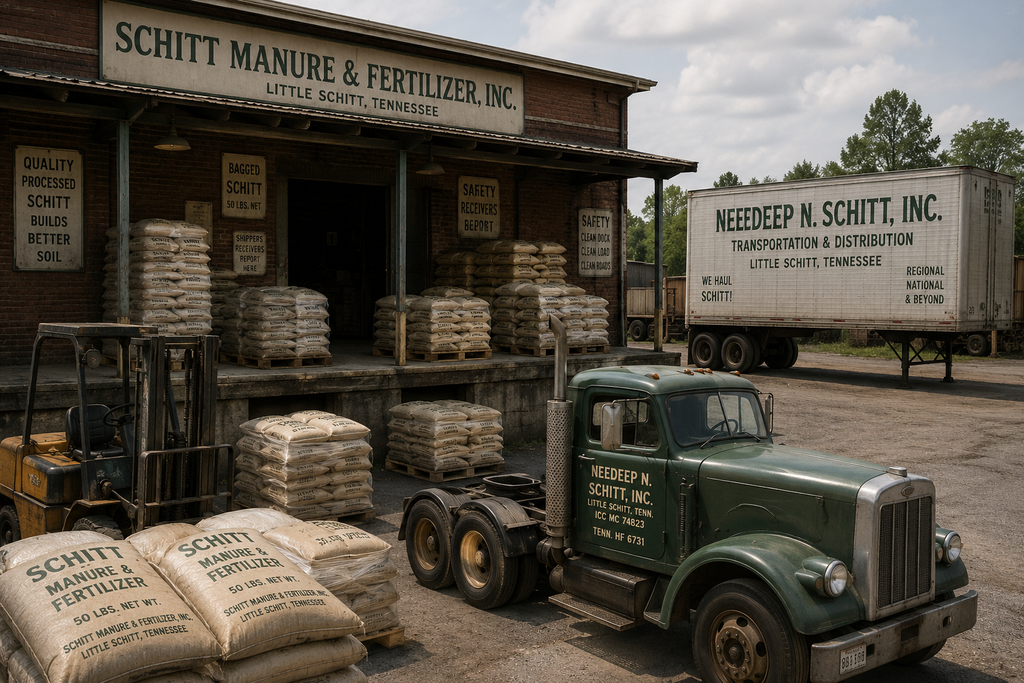
SMFI–NDNSI JOINT SHIPPING YARD — c. 1950s
Collection: Schitt Family Business & Industrial Records
Archive Classification: COMMERCIAL / AGRICULTURAL / TRANSPORTATION
This reconstructed view depicts the loading dock of Schitt Manure & Fertilizer, Inc., during the postwar expansion of the family fertilizer business. Palletized bags of processed agricultural product await shipment while equipment belonging to Needeep N. Schitt, Inc. stands nearby for loading.
By this period, the two independently operated family companies had developed a closely coordinated relationship. SMFI processed, packaged, and sold the fertilizer products; NDNSI provided transportation and distribution to increasingly distant markets.
The arrangement allowed Awe Schitt’s fertilizer operation to expand well beyond Little Schitt without maintaining its own long-distance transportation fleet, while Oh Schitt’s company gained a dependable and steadily growing freight customer.
Archive Note: Surviving business records suggest that trucks were normally loaded directly from the warehouse dock. Employees were reportedly discouraged from referring to outgoing loads simply as “another truckload of Schitt” in customer correspondence, although the practice appears to have continued internally.
Museum Comment: What began with Horace B. Schitt attempting to mechanically scatter manure had, within several generations, become a coordinated processing, packaging, and interstate distribution operation.
Neither company appears to have considered this unusual.
Crock O. Schitt Historical Archives — Agricultural Industry Collection, Record No. SMFI‑NDNSI‑019