Little Schitt’s Crossing Historical Archives
Gallery: Early Settlement & Civic Beginnings
🪶 The Settlement Memorandum of 1869
The Earliest Surviving Civic Record of Little Schitt’s Crossing
This humble sheet of coarse paper is the oldest known document produced by the residents of Little Schitt’s Crossing. Written at a cook‑tent table on June 20, 1869, it represents the moment the proto‑settlers acknowledged — informally, collectively, and somewhat reluctantly — that they had become a community.
Unlike formal charters found in larger towns, the Settlement Memorandum reflects the practical priorities of a frontier swamp settlement:
- keep the ford open,
- keep the mill running,
- keep the coffee strong,
- keep the shouting civil,
- keep the ledger legible,
- and keep the goats from taking over.
The memorandum was recorded by Dorcas L. Pile, whose stitched ledger became the earliest written record of the Crossing. Her handwriting, humidity‑warped and goat‑smudged, remains a challenge for archivists.
👥 Who Signed It?
The memorandum was witnessed by the earliest residents of the Crossing, including:
- Wilder N. Schitt — acting organizer
- Jedediah & Temperance Schitt — wheelwright & cook
- Martha Lou Schitt — settlement announcer
- Ephraim Schitt — cooper
- Dorcas L. Pile — ledger‑keeper
- Johann Grismiller — mill operator
- Simon Quackenbush — merchant
- Maverick & Eliza Mae Stark — livery & cook‑tent
- Henry Waxman — doctor/apothecary
- Jesse Gultch — saloon keeper
- Lester Muldunny — priest
- Jacob Ironton — carpenter/cooper
- Edmond Russell — barber/undertaker
- Three goats — unclaimed
These individuals formed the backbone of the settlement and established the customs that shaped Schitt County for decades.
🐐 Crock’s Archivist Commentary
“Folks call this the Founding Charter, but that’s generous. Wilder weren’t much for paperwork, and Dorcas wrote like she was bein’ chased by humidity.
Still, this is the first time anybody agreed on anything around here.
The ford rule lasted until the Flood of ’72, the mill rule lasted until Johann’s mule ate the ledger, and the shouting rule lasted until Martha Lou got involved.
The goat rule never took hold.
But it’s history, and we keep it — even if it smells faintly of swamp and regret.”
🗂️ Curator’s Note
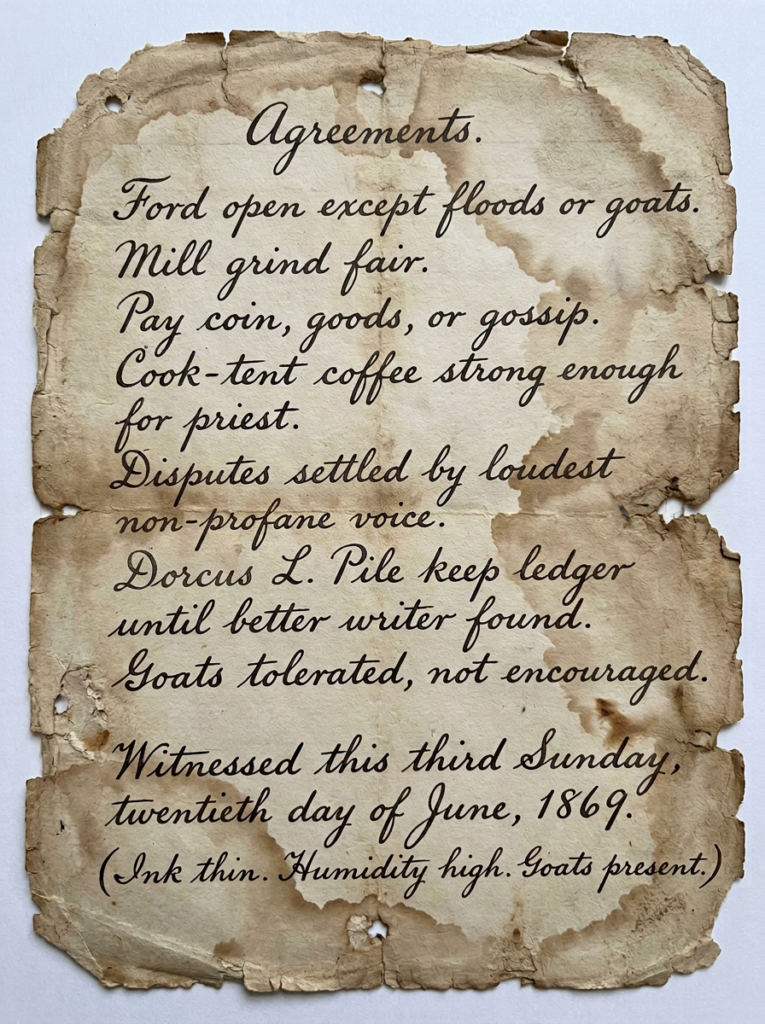
This memorandum is displayed exactly as recovered, including water staining, ink thinning, and the faint hoof‑print in the lower right corner. Visitors are reminded that the Archives cannot guarantee the document is entirely free of goat influence.
🔍 Significance
The Settlement Memorandum marks:
- the transition from wandering families to a rooted community
- the first recorded civic agreements in Schitt County
- the earliest appearance of the Illinois Five in official records
- the moment Wilder’s leadership became recognized
- the foundation of the Crossing’s identity: practical, humorous, and stubbornly functional
It is the cornerstone of the Early Settlement Gallery and one of the most requested artifacts during tours.
🪶 Exhibit: The Settlement Memorandum of 1869
Little Schitt’s Crossing Historical Archives
Artifact 1 — Recovered Document
Medium: Ink on coarse paper Condition: Water‑stained, edges frayed, faint odor of goat Recovered: 1938 — Stark Barn renovation Archivist’s Note: “Found behind a loose board. Paper brittle. Ink thin. Humidity high.”
Agreements Ford open except floods or goats. Mill grind fair. Pay coin, goods, or gossip. Cook‑tent coffee strong enough for priest. Disputes settled by loudest non‑profane voice. Dorcas L. Pile keep ledger until better writer found. Goats tolerated, not encouraged.
Witnessed this third Sunday, twentieth day of June, 1869. (Ink thin. Humidity high. Goats present.)
Artifact 2 — Interpretive Panel
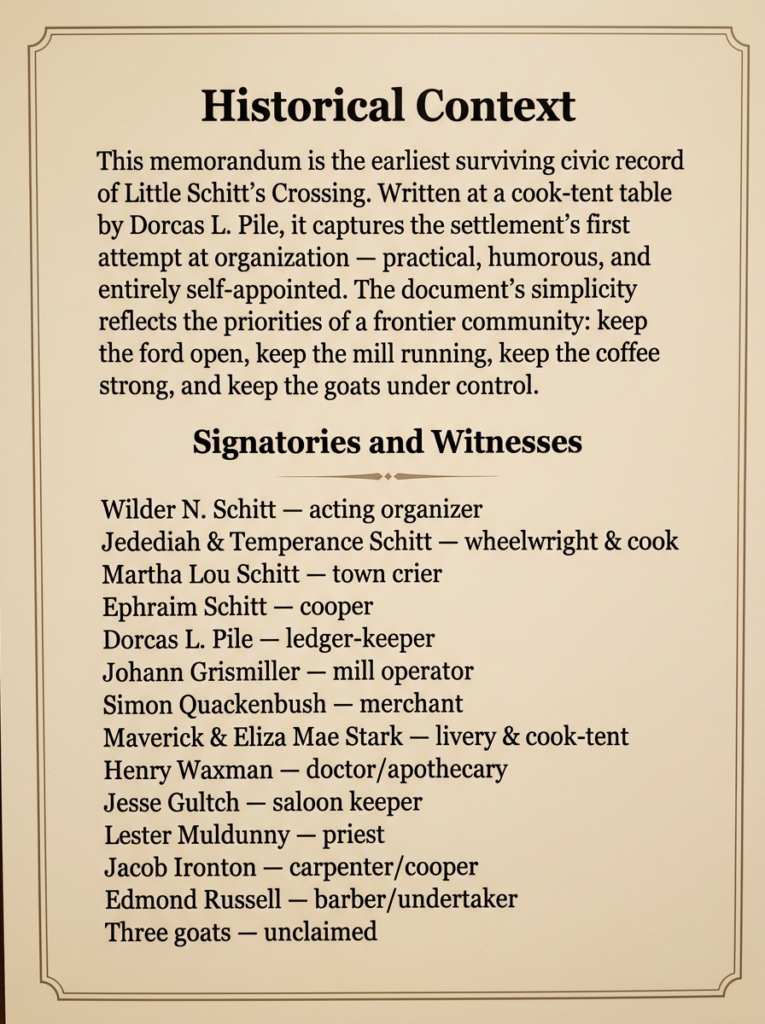
Historical Context
This memorandum is the earliest surviving civic record of Little Schitt’s Crossing. Written at a cook‑tent table by Dorcas L. Pile, it captures the settlement’s first attempt at organization — practical, humorous, and entirely self‑appointed. The document’s simplicity reflects the priorities of a frontier community: keep the ford open, keep the mill running, keep the coffee strong, and keep the goats under control.
Signatories and Witnesses
Wilder N. Schitt — acting organizer Jedediah & Temperance Schitt — wheelwright & cook Martha Lou Schitt — town crier Ephraim Schitt — cooper Dorcas L. Pile — ledger‑keeper Johann Grismiller — mill operator Simon Quackenbush — merchant Maverick & Eliza Mae Stark — livery & cook‑tent Henry Waxman — doctor/apothecary Jesse Gultch — saloon keeper Lester Muldunny — priest Jacob Ironton — carpenter/cooper Edmond Russell — barber/undertaker Three goats — unclaimed
Significance
The Settlement Memorandum marks:
- the transition from wandering families to a rooted community
- the first recorded civic agreements in Schitt County
- the earliest appearance of the Illinois Five in official records
- the moment Wilder’s leadership became recognized
- the foundation of the Crossing’s identity — practical, humorous, and stubbornly functional
It remains the cornerstone of the Early Settlement Gallery and one of the most requested artifacts during guided tours.
🪶 Exhibit: The Ledger of Dorcas L. Pile (1870)
Little Schitt’s Crossing Historical Archives
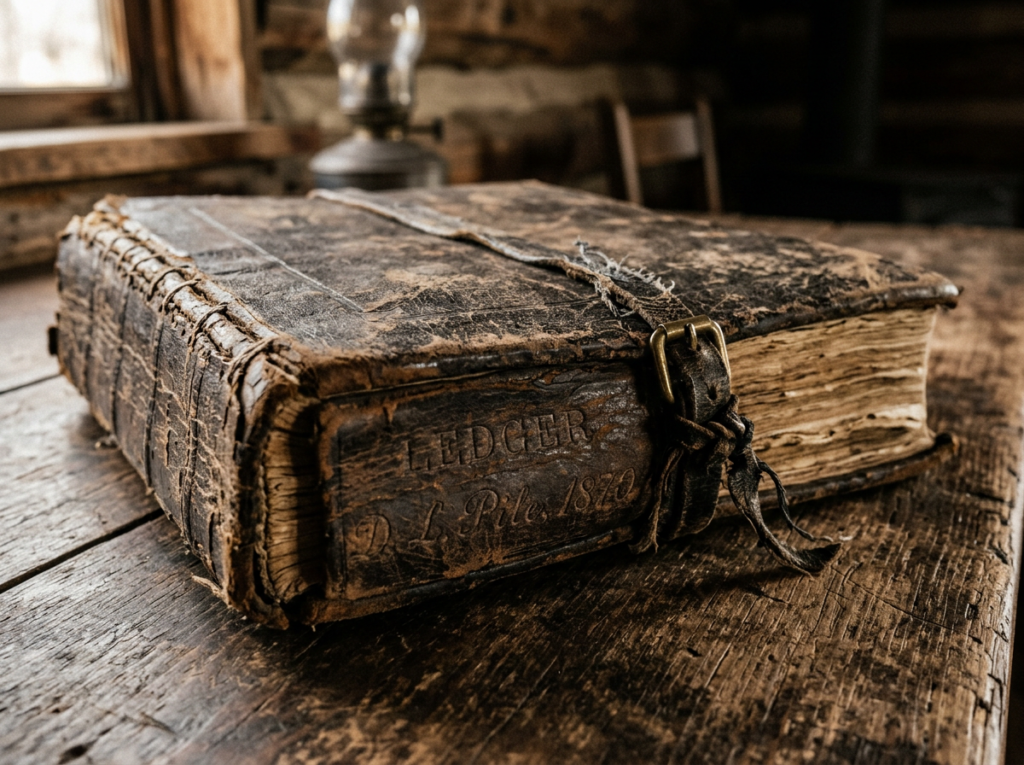
Artifact 1 — The Ledger (Closed View)
Medium: Leather‑bound parchment ledger Condition: Spine cracked, edges frayed, buckle intact Recovered: 1941 — beneath floorboards of the Stark Cook‑Tent Inscription: “LEDGER D. L. Pile 1870” Archivist’s Note: “Binding stitched with thread from Temperance Schitt’s apron. Smells faintly of coffee and goat.”
This volume is believed to be the first continuous civic record kept in Schitt County. Dorcas L. Pile began writing in it shortly after the 1869 Settlement Memorandum, documenting daily life, weather, and the occasional goat incident.
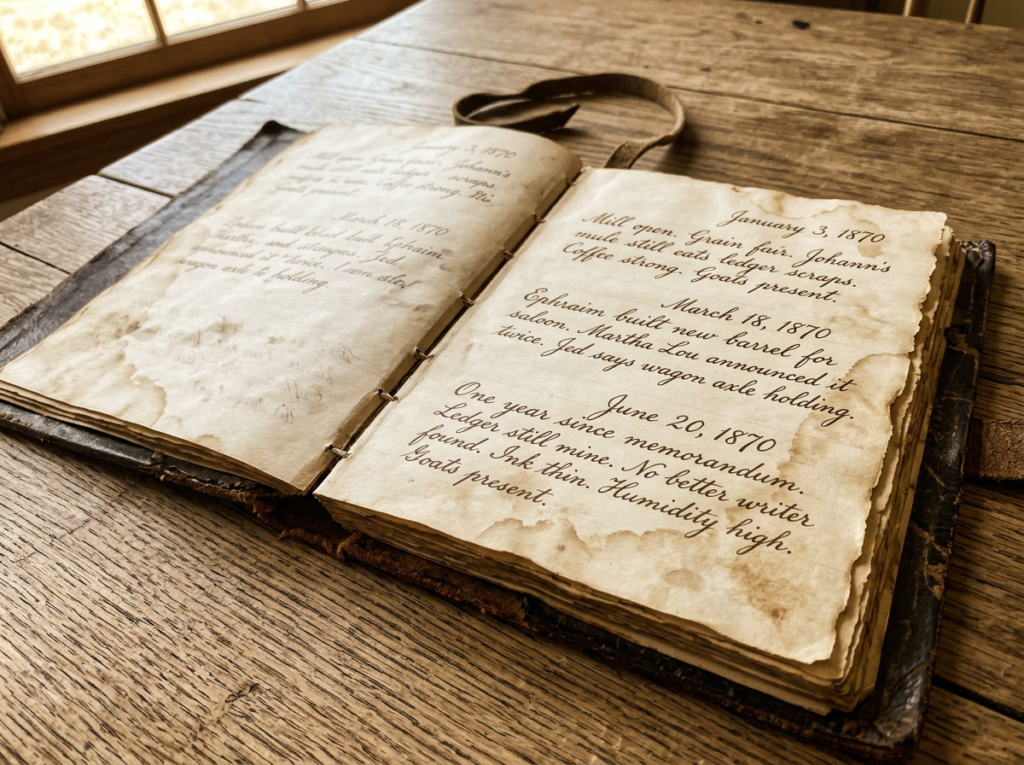
Artifact 2 — Ledger Open to June 20 Entry
Transcription:
January 3, 1870 Mill open. Grain fair. Johann’s mule still eats ledger scraps. Coffee strong. Goats present.
March 18, 1870 Ephraim built new barrel for saloon. Martha Lou announced it twice. Jed says wagon axle holding.
June 20, 1870 One year since memorandum. Ledger still mine. No better writer found. Ink thin. Humidity high. Goats present.
Historical Context
Dorcas’s ledger bridges the gap between the informal 1869 memorandum and the structured civic records that followed. Her entries reveal the rhythm of frontier life — floods, repairs, gossip, and goats — and mark the first anniversary of the settlement’s founding. Though her handwriting was famously poor, her persistence preserved the earliest daily operations of Little Schitt’s Crossing.
Referenced Individuals
- Wilder N. Schitt — acting organizer
- Jedediah & Temperance Schitt — wheelwright & cook
- Martha Lou Schitt — town crier
- Ephraim Schitt — cooper
- Johann Grismiller — mill operator
- Lester Muldunny — priest
- Jesse Gultch — saloon keeper
- Three goats — still unclaimed
🐐 Crock’s Archivist Commentary
“Dorcas wrote like she was fightin’ humidity and losin’. But bless her, she kept at it. Without this ledger, we’d have no idea when the ford flooded, when the coffee ran out, or when the goats staged their first uprising. Folks say history’s written by the victors — around here, it’s written by whoever had ink left.”
Significance
The Ledger of Dorcas L. Pile marks:
- the beginning of continuous record‑keeping in Schitt County
- the first anniversary documentation of the settlement
- the earliest civic maintenance notes (ford, mill, saloon)
- the transition from oral history to written record
- the foundation of the Archives’ record‑keeping tradition
🪙 Exhibit: S. Quackenbush Mercantile (1873 – 1880)
Little Schitt’s Crossing Historical Archives
Artifact — Photograph of the Mercantile
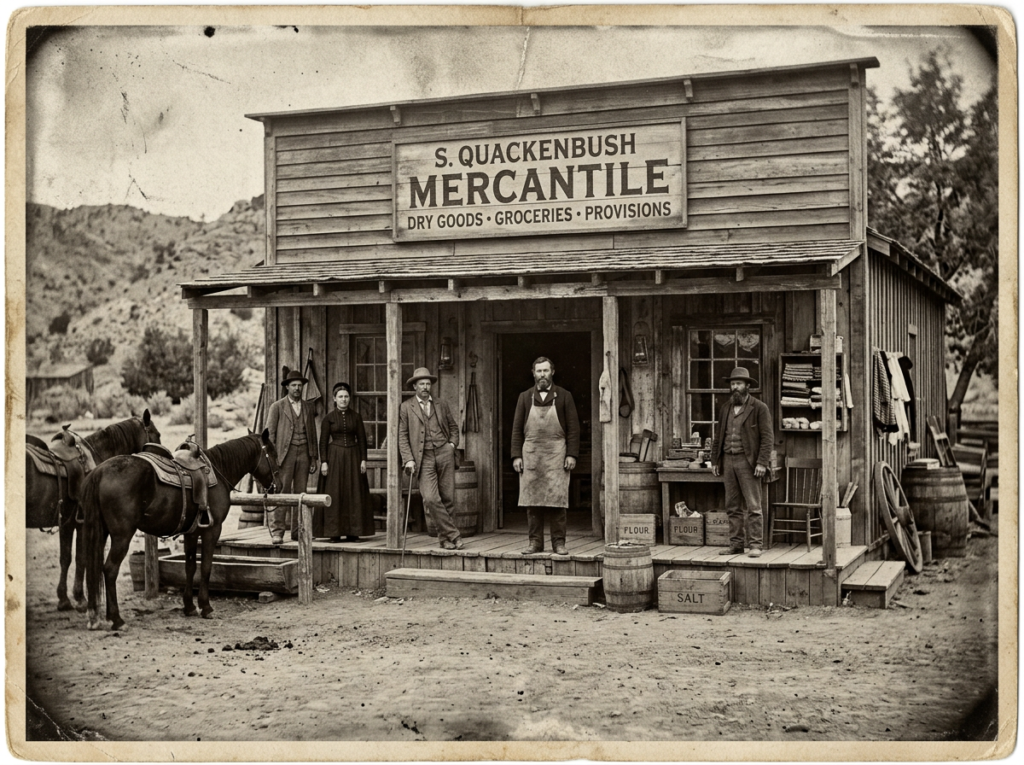
Medium: Albumen print on card stock Condition: Slight fading, corner wear, minor surface abrasion Recovered: 1952 — from the Quackenbush family trunk Visible signage: S. QUACKENBUSH MERCANTILE Dry Goods • Groceries • Provisions
Historical Context
By 1873, Simon Quackenbush’s mercantile had become the settlement’s primary source for dry goods, flour, salt, and basic provisions. The structure shown here — wood‑framed with a front porch and hitching post — matches Dorcas L. Pile’s ledger entries describing “Simon’s porch barrels and flour boxes.” The store served as both trading post and informal meeting place, linking Little Schitt’s Crossing to neighboring communities.
Identified Individuals (verified from ledger and family records)
- Simon Quackenbush — merchant and proprietor
- Wilder N. Schitt — acting organizer, frequent visitor
- Jedediah Schitt — wheelwright, supplier of wagon parts
- Ephraim Schitt — cooper, provided barrels for goods
- Dorcas L. Pile — ledger‑keeper, recorded trade tallies
- Two unidentified laborers — likely hired hands from the mill
- Two horses — unclaimed, presumed local transport stock
Ledger References
- March 1873: “Simon added salt barrel and two flour boxes. Trade fair.”
- June 1874: “Market day held at Simon’s porch. Coffee strong. Goats present.”
- October 1876: “Simon traded grain for tools from Crab Orchard men.”
These entries confirm the mercantile’s role as the settlement’s economic hub during the growth decade.
Significance
The Quackenbush Mercantile represents:
- the first permanent commercial structure in Little Schitt’s Crossing
- the center of trade and social exchange during 1873–1880
- the link between proto‑settlers and regional supply routes
- the physical evidence of the settlement’s transition from subsistence to commerce
🧾 Crock’s Archivist Commentary
“Simon kept his store open longer than anyone kept their temper. Folks came for flour and left with news, coffee, and arguments about goats. If you wanted to know what was happenin’, you stood on that porch and listened.”