Little Schitt’s Crossing
Founded by Wilder N. Schitt, c. 1869
Southwestern Tennessee — family settlement, trading crossroads, and recurring source of questionable documentation.
ARCHIVE STATUS: ACTIVE — Family accounts, business records, local history, and assorted debris remain under review.
The Scant Beginnings of Little Schitt’s Crossing
Sometime around 1868, Parrot Schitt, his wife Polly, and Wilder N. Schitt loaded what they figured they’d need into a wagon and headed west. Leastways, west was the stated objective. Family accounts indicate they initially made some progress in that direction before hooking north for reasons nobody adequately documented, then eventually rediscovering west sometime later. Missouri, Wisconsin, Dakota—records disagree, memories are worse, and Cousin Deep maintains that anybody trying to reconstruct the route from family testimony deserves whatever happens to them. Wilder had started the journey with a map, which demonstrated unusual foresight for a Schitt. Unfortunately, Polly ended up carrying it. Polly apparently did not know it was a map and later couldn’t recall what she’d done with it. Compasses, according to Schittlore, were evidently scarce.
The journey itself appears to have been considerably longer than necessary. As the wagon rolled on, Wilder was reportedly subjected to an almost continuous exchange between his traveling companions: “Parrot—Polly—Parrot—Polly—Parrot—Polly…” At some point their wagon joined several others, and for a time the travelers exchanged stories, news, opinions, religion and politics. The last two subjects proved particularly unfortunate. The wagons eventually separated following what family tradition describes only as “considerable disagreement.” When Wilder finally regained his bearings, things had become suspiciously quiet. Parrot and Polly were gone. Wilder vaguely remembered another wagon, an outspoken woman named Calamity, and some discussion suggesting Polly may have discovered distant kin. Whether Parrot and Polly intentionally changed wagons or Wilder simply failed to notice them leaving remains unresolved.
Freed from Parrot and Polly—and apparently still uncertain which direction constituted west—Wilder continued alone in pursuit of the fortune he was convinced awaited him. What he found instead was a swamp. Why Wilder stopped there is one of the earliest mysteries associated with Little Schitt’s Crossing. Perhaps he was exhausted. Perhaps the wagon broke. Perhaps the land was available. Perhaps Wilder simply decided that after everything he’d endured, wherever he happened to be was where he intended to have been all along. Whatever the reason, sometime around 1869, Wilder N. Schitt quit wandering and established the little settlement that would eventually become known as Little Schitt’s Crossing.
It wasn’t much at first. A few structures, scattered households, livestock, mud, and—according to an unreasonable number of surviving family references—goats. The earliest population figure is uncertain; the old claim that the settlement peaked at thirteen inhabitants probably belongs to one particular early period rather than the community’s eventual size. What does seem clear is that Wilder was not alone for long. Other settlers appeared, including several Schitt relatives whose exact relationships remain frustratingly unclear. Somehow, despite poor roads, questionable directions and Wilder himself having reached the place largely by accident, more than one Schitt managed to find the same swamp. It wus talked bout, but never clear, but speculation has it the the goats assisted, how go figure.
As families accumulated, the little settlement developed into an actual crossing community. Farms and livestock operations spread into the surrounding country, travelers passed through, and eventually Simon Willem Quackenbush, a merchant and landowner, recognized something Wilder apparently hadn’t: there was money to be made there. Quackenbush established the mercantile, supplying the surrounding households with flour, coffee, cloth, feed, tools, hardware, lamp oil and the assorted necessities of rural life. More importantly for later reconstruction, Quackenbush kept records. Over succeeding decades his store and the community around it would serve Lemuel Schitt, Crystobell Schitt, Eunice Schitt, Bewilder Schitt, Honour Schitt, Otto and Martha Schitt, Etta Lott Schitt, Nora Belle Schitt, Hugh Givva Schitt, Dewey Cecil Schitt, and other relatives, neighbors and travelers who gradually turned Wilder’s swamp settlement into a thriving little community.
The mercantile gave Little Schitt’s Crossing a commercial center, but the Schitt’s – n’ others — gave it character. Hugh connected the settlement to county affairs through his courthouse work. Bewilder and Honour belonged to the agricultural community surrounding it. Otto and Martha brought mechanical ingenuity and a growing fascination with aviation into a place still accustomed to wagons and farm machinery. Dewey Cecil eventually became associated with books and records. Etta Lott and Nora Belle, meanwhile, became known for cooking—especially Etta’s pies—and the later development of Etta’s Diner gave people another reason to stop instead of merely passing through. What Wilder had established by accident was becoming a functioning community through accumulation rather than planning.
Exactly when Little Schitt’s became Little Schitt’s Crossing can remain disputed. Wilder founded the settlement around 1869; the “Crossing” likely became customary only as roads, trade and traffic made the description useful. Population estimates should likewise change with the period being discussed. Wilder’s original settlement may indeed have contained barely a dozen souls, while the later community serving several generations of Schitts and associated families would necessarily have been larger. That gives us room for the old “population 13” story to survive without making the later settlement impossible.
And through all of it, the goats remained.
Material Recovered From Little Schitt’s Crossing
The following records, collections, and family materials have been associated with the settlement. Cataloging remains incomplete.
Quackenbush Mercantile Records
Simon Willem Quackenbush — Proprietor, Merchant & Landowner
The mercantile became one of the earliest commercial anchors of Little Schitt’s Crossing, supplying surrounding households, farms, and travelers with ordinary necessities. Surviving account records are believed to document several generations of Schitt family activity in and around the settlement.
Archive contents: Ledgers, customer accounts, receipts, supply records & assorted business papers.
STATUS: PARTIALLY CATALOGED
Etta’s Diner & Community Records
Etta Lott Schitt & Nora Belle Schitt
Family accounts remember Etta as an exceptional cook and credit both sisters with developing one of Little Schitt’s Crossing’s better-known gathering places. Etta’s pies received particular mention in later family recollections. The exact opening date of the diner remains unresolved.
Archive contents: Family recollections, recipes, photographs, business material & community references.
STATUS: UNDER RECONSTRUCTION
Otto & Martha Schitt — Mechanical Records
Otto B. Schitt & Martha Eloise (Fokker) Schitt
Otto, a machinist and persistent tinkerer, developed an early fascination with aircraft and mechanical devices. Martha shared his curiosity and became capable at repairing and solving mechanical problems alongside him. Their activities reflect the gradual arrival of new technology in Little Schitt’s Crossing during the early twentieth century.
Archive contents: Workshop material, mechanical records, family recollections, photographs & aviation-related material.
STATUS: MATERIAL IDENTIFIED — NOT YET CATALOGED
County & Civic Records
Little Schitt’s Crossing — County & Community Material
As the settlement grew, its residents increasingly appear in courthouse records, property matters, local correspondence, business transactions, and other civic documents. Hugh Givva Schitt, who worked as a courthouse clerk, provides one of the stronger connections between Little Schitt’s Crossing and surviving county records.
Archive contents: Property records, courthouse material, correspondence, legal notices, community records & miscellaneous county documents.
STATUS: RECORDS SCATTERED — REVIEW ONGOING
Known Residents & Associates
Wilder N. Schitt — Founder, c. 1869
Lemuel Schitt (SCH-0030) — Resident; later associated with Crossing records
Crystobell Schitt (SCH-0042) — Resident; mercantile records
Eunice Schitt (SCH-0043) — Resident; mercantile records
Bewilder Overawe Schitt (SCH-0060) — Farmer & cattleman
Honour Schitt (SCH-0061) — Resident; Bewilder household
Otto B. Schitt (SCH-0067) — Machinist & tinkerer
Etta Lott Schitt (SCH-0068) — Cook; Etta’s Diner
Nora Belle Schitt (SCH-0069) — Etta’s sister; diner/community
Hugh Givva Schitt (SCH-0070) — Courthouse clerk
Dewey Cecil Schitt (SCH-0071) — County librarian
Martha Eloise (Fokker) Schitt (SCH-0074) — Mechanic; Otto household
Simon Willem Quackenbush — Merchant & landowner; mercantile proprietor
This roster reflects currently identified residents and associates. Additional relationships and periods of residence remain under reconstruction.
Unresolved Questions & Disputed Records
Population of Little Schitt’s Crossing
Early family accounts place the population at approximately 13 during one period of Wilder’s settlement. Later records indicate a larger community. The date and accuracy of the original count remain unresolved.
Quackenbush Mercantile
The mercantile’s existence and association with the community are established within family records; its opening date and earliest surviving account material remain under reconstruction.
Early Schitt Relationships
Several Schitts associated with the Crossing appear to be cousins or members of collateral branches. Exact relationships remain unresolved pending reconstruction of earlier generations.
The Name
Wilder N. Schitt founded the settlement around 1869. When “Little Schitt’s” became commonly known as “Little Schitt’s Crossing” has not yet been established.
Goat Activity
Documented repeatedly. Explanation lacking.
Related Archive Trails
Wilder N. Schitt — Founding Records
Migration west, c. 1868; establishment of Little Schitt’s, c. 1869.
The American Schitt Beginnings
Boris E. Edward Schitt and the earliest reconstructed American family records.
The Abigail Ruth Collection
Family letters, births, recipes, keepsakes, reconstructed material & records associated with the Great Goat Incident, c. 1886.
Arkansas & the Chitty Connection
Daniel Roosevelt Schitt, Jacqueline Chitty, the Chitty printing business, and the developing Arkansas branch.
The Official Schitt Family Register
Names, relationships, dates, identifiers & current reconstruction status.
Additional trails will be opened as materials are cataloged, relationships untangled, and records become fit for public consumption.
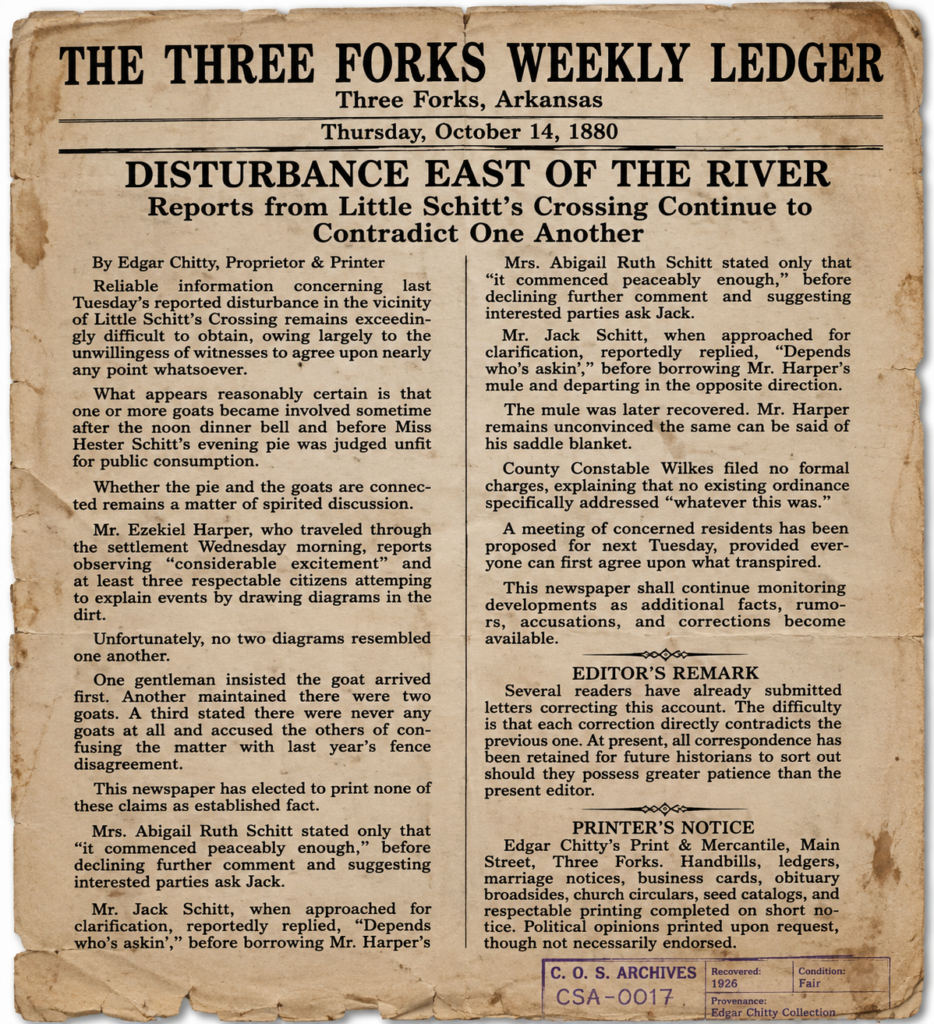
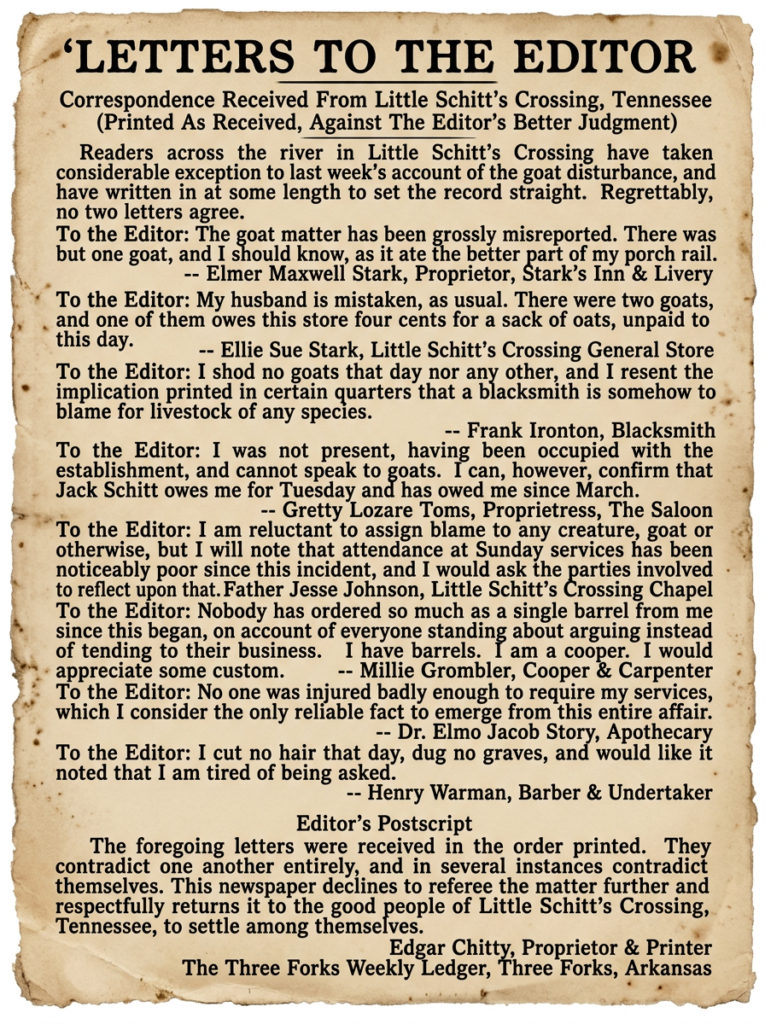
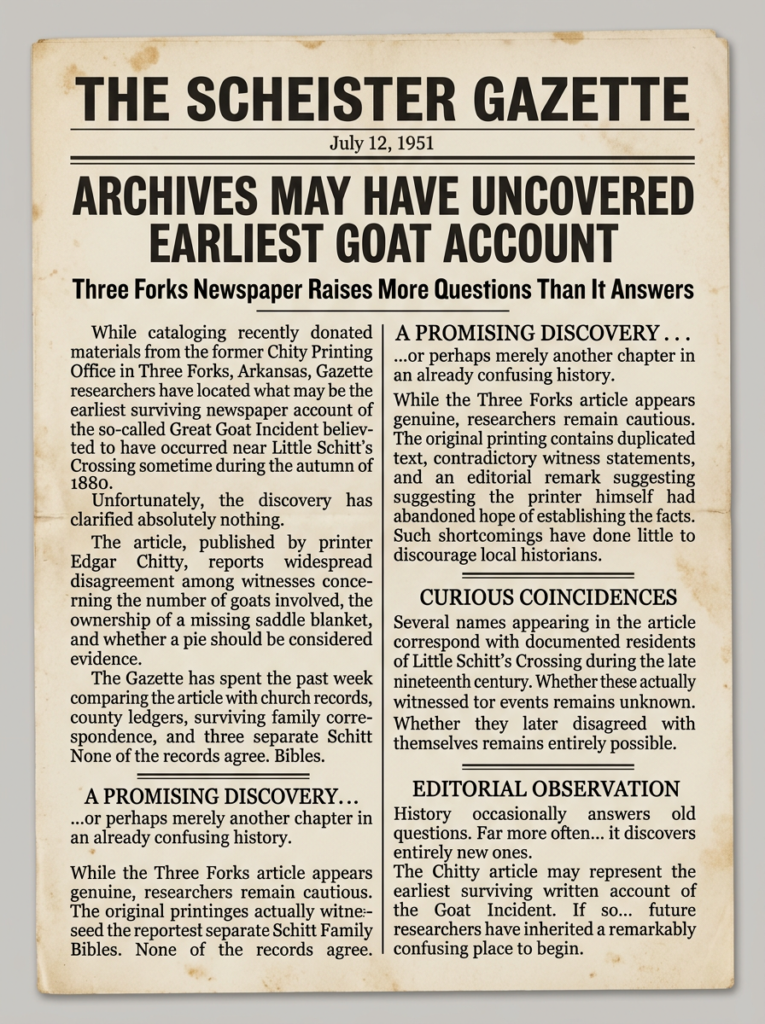
Research File: GGI-1880-01
Status: Open
Confidence: Low
Primary Sources: 2
Witnesses: Contradictory
Goat Count: Undetermined