SCHITT FAMILY ARCHIVES — INVENTIONS & AGRICULTURAL IMPROVEMENTS
Record: HOR-SCH-01
Subject: Horace Schitt
Period: Early Industrial Era
Status: Historical attribution remains under review
Now ole Horace Schitt was a respectable man, yep.
Least that’s how the family remembers him fer the most part
Horace came ‘long during that period when folks were discoverin’ steam could make machines do a whole lot more work than folks could — and without complainin’ near as much.
Factories were makin’ things faster. Drillin’ machines were drillin’ deeper. Farm machinery was makin’ work easier.
Horace saw all this progress and, in good conscience with the family name, decided agriculture deserved its share.
Specifically, manure.
Horace reasoned that if a farmer could spread manure across an entire field quickly, he’d spend less time fertilizin’ and considerably more time attendin’ to other important agricultural matters.
So he set about inventin’ a steam-powered manure spreader.
Tinkered with the design for months.
Boiler worked.
Drive mechanism worked.
Spreader worked.
Matter of fact, near everything on Horace’s machine worked perfectly.
Sorta.
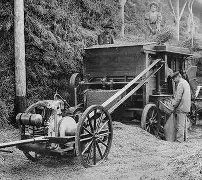
The difficulty wasn’t gettin’ it started.
The difficulty was once ya started it—
it was goin’.
Goin’.
Goin’.
And it continued goin’ until it either ran outta steam, manure, field, or some combination thereof.
The first public demonstration was reportedly well attended.
For a while.
Horace fired the boiler, engaged the machinery, and proceeded across the test field at what witnesses initially described as an impressive rate of agricultural progress.
At the far end of the field, Horace attempted to turn.
The machine apparently had other ideas.
No barn was safe.
No house was far enough away.
Several fences ceased performin’ their intended function.
At least two outbuildings were reportedly lost during the demonstration, although County records remain unclear whether they were actually destroyed or simply rendered unsuitable for continued occupancy.
The machine eventually exhausted its steam some distance beyond the original demonstration area.
By then, much of that side of town had been thoroughly fertilized.
Thoroughly.
Folks avoided the area for weeks.
One surviving account claims the smell reached Little Schitt Crossing three days before Horace did.
County officials subsequently acknowledged that the machine had demonstrated “considerable potential for rapid agricultural distribution.”
They declined to authorize a second demonstration.
For ole Horace…
things jus’ didn’t work out.
ARCHIVIST’S NOTE
No authenticated example of Horace Schitt’s original steam-powered manure spreader is known to survive.
Several later manure spreaders have nevertheless been attributed to Horace by family members, auctioneers, local museums, and at least one fellow who was apparently tryin’ to sell one.
The Archives have been unable to substantiate these claims.
Mechanical similarities alone are considered insufficient evidence of provenance, particularly since most manure spreaders share the unfortunate characteristic of being designed to spread manure.
The Archives take no position on these claims.
We have learned better.
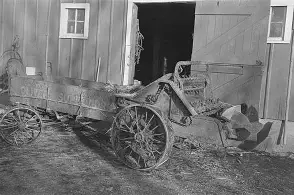
MUSEUM RECORD
Object: Agricultural Manure Spreader
Attribution: Horace Schitt Agricultural Works — Unverified
Date: Unknown
Provenance: Disputed
Condition: Used
Traditionally identified as a later descendant of Horace Schitt’s experimental steam-powered manure spreader. Examination has revealed no steam engine, boiler, steering deficiency, or other evidence sufficient to establish direct descent.
The implement does, however, appear fully capable of spreading Schitt.
Museum Note: Operational testing has been declined.
RELATED ARCHIVAL HOLDINGS
Schitt’s Business — Family enterprises, agricultural ventures, and other attempts at respectable commerce.
Colonial Schitts — 1770–1849 — Founding families, questionable arrivals, and the earliest documented Schitts.
Annotated Regrets — Corrections, disputed accounts, unexplained objects, and incidents requiring considerably more explanation than the Archives possess.
Additional records concerning Horace Schitt may exist. County officials have expressed no enthusiasm for locating them.