Magdalena Schittner — Seamstress & Wigmaker
Surviving trade references suggest Magdalena Schittner worked as a seamstress and occasional wigmaker, although the distinction between the two occupations appears to have become less clear as her career progressed.
One account describes a gentleman arriving for alterations to a waistcoat and departing several hours later wearing “considerably more hair than circumstances required.”
Magdalena’s work appears to have enjoyed a modest regional reputation.
Whether her business contributed to the family’s later migration remains uncertain.
Several portraits from the period have yet to be satisfactorily explained.
A surviving trade notation associated with Magdalena Clare Schittner appears to record the surname simply as “Schitt.” Whether this represents abbreviation, transcription, or deliberate usage remains unresolved. No reason given, that particular record has been through some rough handling, but that is what it appears to indicate.
Fragmentary Trade Entry — c. 1703
Received of Magdalena Schitt, seamstress, alterations to one gentleman’s waistcoat, replacement buttons, and dressing of one peruke.
Additional charge assessed for hair.
Archive Observation: The surname in this entry appears without the -ner suffix. The handwriting is otherwise reasonably legible. The identity of the gentleman, the amount of hair involved, and why it warranted a separate charge remain unknown.
Konrad Jorge Schittner — The Inconvenient Brother
Konrad Jorge Schittner, born about 1685, appears only intermittently in the surviving family record.
Unlike several of his siblings, no occupation has been reliably attributed to him, and much of his later history remains fragmentary.
What survives would be considerably less interesting were it not for the timing.
Account Notation — c. 1706
A fragmentary account concerning the purchase and delivery of two barrels, lamp oil, nails, and an unspecified quantity of rope records the purchaser as:
Konrad Jorge Schittner.
The surname is plainly written and appears complete.
This entry dates approximately three years after the surviving trade notation identifying his sister as Magdalena Schitt.
Archive Observation: Whatever caused the apparent shortening of Magdalena’s surname had evidently not yet inconvenienced Konrad.
No explanation accompanies either record.
A second fragment, believed to date several years later, contains only the notation:
“K. J. Schittner — paid.”
What he paid for has not survived.
That he paid at all has been noted with some admiration by later members of the family.
Archival Significance
Konrad’s surviving records complicate any suggestion that the Schittner surname changed uniformly or at a single identifiable point.
For at least part of the early eighteenth century, Schittner and Schitt appear to have existed simultaneously within the same immediate family.
Whether this resulted from personal preference, clerical practice, regional usage, handwriting, family disagreement, or Magdalena simply becoming tired of writing the rest of it remains UND.
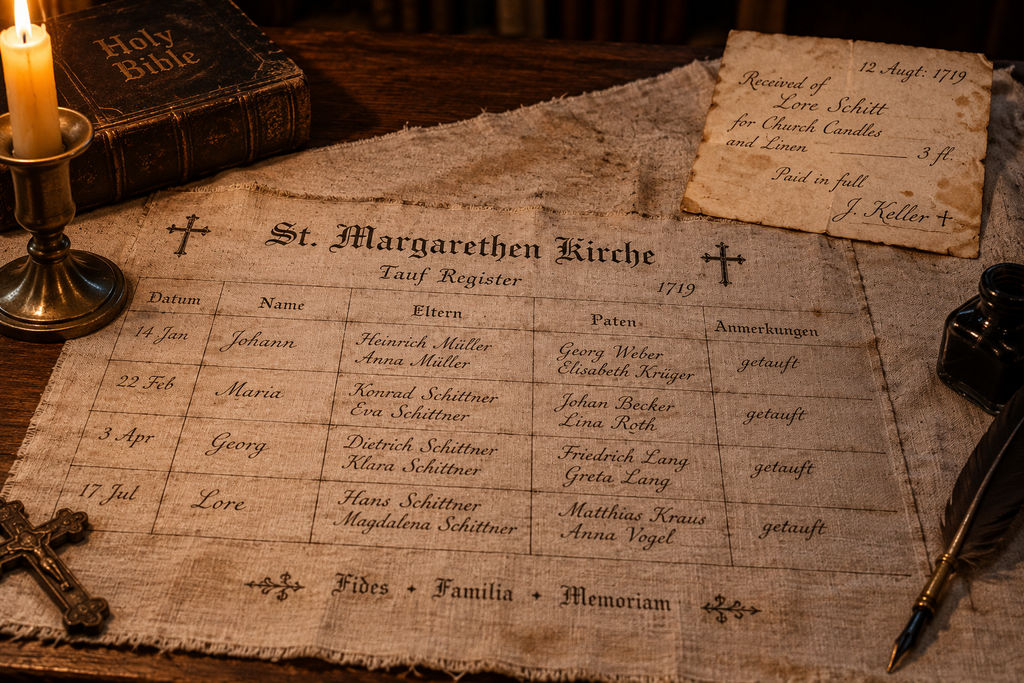
MUSEUM RECORD
Object: Parish Register & Associated Receipt
Attributed Date: 1719
Collection: Early Family Fragments
Material: Linen, paper, ink; associated ecclesiastical materials
Condition: Age-related wear, staining, edge deterioration; legibility generally serviceable
Museum Note:
Surviving parish materials attributed to 1719 contain several references associated with the Schittner family. An accompanying receipt, recovered with the materials, records the surname Schitt without the -ner suffix.
The relationship between the receipt and the parish register has not been conclusively established. Both were reportedly preserved together when the materials entered the Archive collection.
The receipt appears to concern church candles and linen.
Why Lore Schitt was paying for either remains UND.
Archive photograph. Materials reproduced for research and exhibition purposes.