The current American Beginnings starts exactly where it should: Boris E. Edward Schitt, c.1591, then Virginia c.1612.
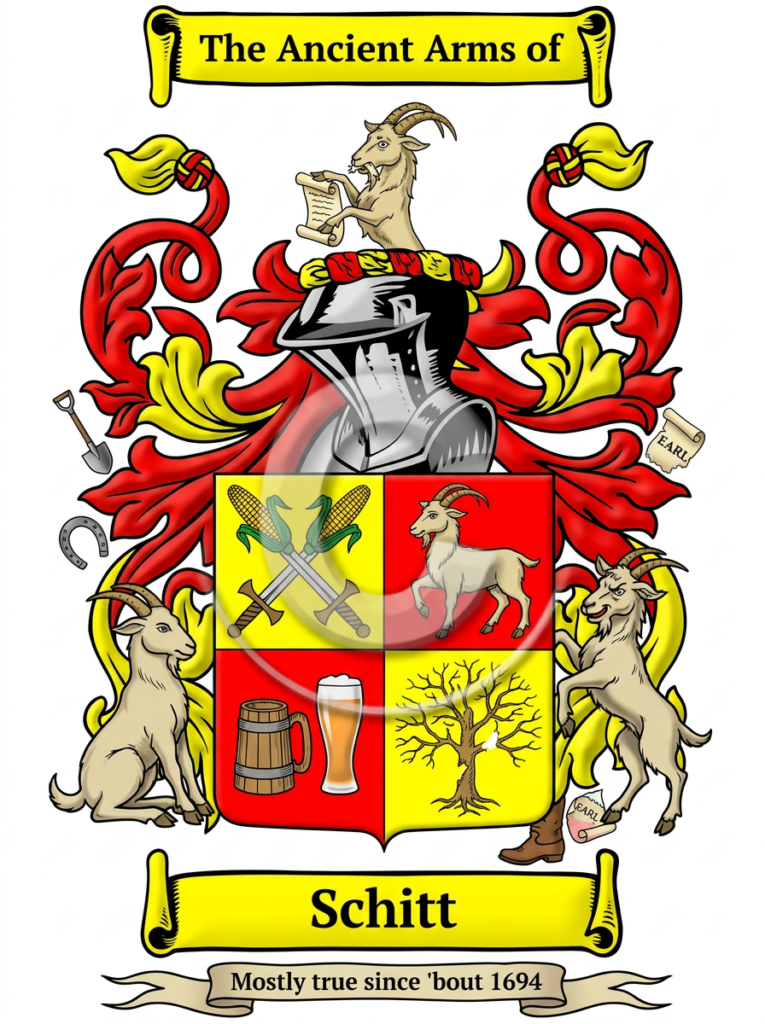
The American Beginnings of the Schitt Family
Let me jus’ say – We need ta’ talk ‘bout a few things afor we git inta some, well, muddy waters as far as jus’ how Schitts came over here to ‘Merica. I’m just sayin, records weren’t always made er kept, n a whole lotta people slipped tween them cracks ‘er crannies -SO- piecin’ tagether how things came ta be is not easy. Now we tried hard to fit all them puzzle pieces together where they belong. Can’t take narry credit fer most a this here history —- cept for diggin’ in places most people avoid. The thing here – we know from records n’ RECORDS ARE RECORDS!
THE FIRST AMERICAN SCHITTS
The American Schitt record begins, so far as anybody has been able to reconstruct it, with Boris E. Edward Schitt, born around 1591.
Boris was not an explorer, gentleman adventurer, wealthy planter, or man apparently destined for historical importance. He arrived in Virginia around 1612 as an indentured servant, part of the continuing movement of labor and supplies into the struggling English colony. Precisely how he got there is still disputed.
Several later family accounts insist Boris arrived aboard an important vessel. Unfortunately, none agrees on which important vessel it was. One nineteenth-century transcription identifies a ship whose records show it was somewhere near England at the time. Another gives no ship at all but confidently records that Boris “got off on the wet side.”
That has not helped.
What the surviving material does support is considerably less glamorous: sometime in the early 1610s, Boris Schitt was in Virginia and apparently working off somebody else’s investment in getting him there.
Considering mortality in the colony, simply remaining alive may have been his first notable accomplishment. Family tradition remembers Boris as practical, durable, stubborn, and possessed of the useful ability to eat almost anything placed before him without asking what it was.
One account adds: “Boris learnt early not ta complain bout supper. Supper might hear ya.”
The author is unknown. We suspect Crock.
Those first years gave Boris little reason to believe America had been a particularly good decision. Disease, hunger, poor harvests, shortages and conflict had already killed astonishing numbers of settlers. Boris survived. There is no record of heroics.
No great land grant bears his name. No surviving colonial official seems to have considered him important enough to write much about. He appears instead in the manner most Schitts eventually do:
somewhere in somebody else’s paperwork.
A labor notation here. A damaged reference there. A name that may be his on an account nobody completely understands. It is frustrating for genealogists. It is also probably why we trust it.
RECORDS ARE RECORDS.
Then, around 1619–1620, Maggie Sue Albert entered the reconstructed family record.
Maggie, born around 1601, appears to have been among the women arriving in Virginia during the effort to turn a precarious settlement of mostly men into something resembling a permanent society. Family tradition remembers Maggie as quiet, grounded, practical and resourceful. This should not be mistaken for timid.
One damaged family note describes her as: “a woman of few words who generally required only one.” The remainder of the page is missing.
Boris and Maggie appear to have met soon after her arrival. Whether affection came first is unknown. Survival, proximity and the limited selection of available spouses probably deserve some credit.
By 1620 they were married. No surviving account describes the ceremony. This is probably fortunate. Their marriage established the first presently documented American Schitt household. And whatever brought them together, it worked.
Their first documented child, Mary Beth Schitt, arrived around 1621. Isaac Walter Schitt followed in late 1623. Mary Beth is one of the more frustrating people in the early archive. She is there—and then she isn’t. Nothing presently proves she died young. Nothing proves she married. Nothing proves she didn’t. The surviving family record simply loses her. That distinction matters.
For generations, family genealogists handled missing women by quietly assuming their line ended. The Museum does not. Missing is not dead. Unknown is not none.
Somewhere beyond the surviving scraps may be an entire branch of American Schitts descended from Mary Beth. We simply cannot prove it. Yet. Isaac Walter leaves a slightly better trail. Family reconstruction suggests he survived into adulthood and probably established at least one continuing branch. Unfortunately, the documents that would tell us precisely which later Schitts belonged to Isaac are among those known to have existed and later disappeared.
Some were lost through ordinary time. Some through poor storage. Some through family moves. And some, considerably later, through the unfortunate convergence of archival material and livestock during what family historians now call the Great Goat Incident of 1886.
Precisely what happened remains disputed. The generally accepted account holds that a collection of older family papers had been temporarily stored in an outbuilding while portions of the family home were being repaired. At some point, a goat gained access.
How the goat gained access depends entirely upon which Schitt you ask.
Surviving testimony from Abigail Ruth (Carter) Schitt maintains that she was rescuing the records when discovered among scattered papers, damaged bindings and what one later account delicately describes as “material no longer suitable for archival reconstruction.”
Abigail blamed the goat. Another family member blamed Abigail. The goat’s name is not recorded. This may be the only instance in Schitt family history where nobody named the goat.
Several documents survived intact. Others survived only in portions. A few scraps and part of at least one binding were reportedly recovered. The goat offered no statement. The Museum considers the matter unresolved.
1644
Boris died in 1644 during the period of the Third Anglo-Powhatan War.
Family tradition has long connected his death to the violence surrounding that conflict, but this is one place where the archive refuses to improve the story merely because an improved story would sound better. We do not know how Boris died. He may have been killed in the conflict. He may have died because of conditions resulting from it.
He may have died in 1644 while a war happened to be occurring around him. Three centuries of Schitts have argued the distinction. None were there.
RECORDS ARE RECORDS.
Maggie survived him until around 1649. By then Mary Beth was approximately twenty-eight and Isaac approximately twenty-five. The first American Schitt children had reached adulthood. And then— the trail goes to hell.
THE MISSING SCHITTS
For much of the remainder of the seventeenth century, we know Schitts existed. We just can’t always prove which Schitt belonged to which Schitt. There are names. Fragments. Possible marriages. Land references. Church entries that might belong to the family. Court entries that almost certainly belong to the family.
Unfortunately, seventeenth-century clerks were not writing records for the convenience of a goat-operated family museum four hundred years later. The temptation is enormous to connect the pieces. We won’t. Isaac probably had descendants. Mary Beth may have had descendants. Other related Schitts may have arrived independently.
Several later branches claim descent from one or the other. At least one old family chart manages to descend from both, which would require an explanation nobody here particularly wants.
Crock studied that chart for two days. His final notation reads: “Cousins. Damn.”
We have retained the original. There is, however, evidence of movement. By the late seventeenth and early eighteenth centuries, surviving references suggest the family was no longer confined to the original Jamestown-area settlement. Like thousands of other Virginia families, descendants and collateral kin appear to have followed land, marriage, work and opportunity inland and along the James.
Eventually the trail begins pointing toward Bermuda Hundred and the surrounding Virginia country. And suddenly, after generations of shadows, familiar names start appearing again.
Ashley W. Schitt — born 1712.
Bonnie Butler — born 1717.
Amos Leam Schitt — born 1718.
Jock Oakley Schitt — born about 1723.
Then Rebecca Noe Shekels — born about 1731.
We cannot yet draw an unbroken line from Boris and Maggie to every one of them. But now there are enough Schitts in the records that losing all of them becomes considerably more difficult. They also begin doing something extraordinarily useful for future genealogists: arguing with their neighbors.
AMOS, REBECCA & THE FENCE
Amos Leam Schitt might have disappeared into the same genealogical fog as several generations before him had it not been for a disputed boundary fence.
There are many reasons to appreciate government records. This is one of them. Family material places Amos in a disagreement concerning where one man’s property stopped and another man’s began. Precisely how serious the dispute became varies according to which descendant tells it. The family version involves shouting, a sheriff, livestock, two fence posts and somebody’s hat. The surviving paperwork is less entertaining. But it exists.
And because somebody couldn’t agree where to put a fence, Amos Schitt became harder for history to lose. This is an important principle in Schitt genealogy: Behave yourself and you may disappear from history. Cause trouble and somebody writes it down.
Amos later became entangled with Rebecca Noe Shekels, despite objections reportedly coming from her father. Rebecca quilted. Amos apparently argued. Between the two, Rebecca produced the more durable work. At least one later family account claims that a surviving quilt contained fabric pieces associated with several branches of the family and was once used by researchers attempting to identify relationships during the missing generations. According to the account, scraps were said to have come from wedding dresses, work shirts, children’s clothing and at least one pair of trousers nobody could satisfactorily explain.
Unfortunately, Rebecca did not label any of them.
Later generations attempted to identify the pieces by pattern, stitching, family recollection and, in one particularly ambitious effort, who remembered seeing somebody wear what.
Results were mixed.
No one has successfully demonstrated that a quilt can prove genealogy.
Crock is still optimistic.
Then there’s Jock Oakley Schitt, born around 1723 and remembered as Amos’s second cousin. Second cousin how is precisely the question. If the relationship is correct, Jock may be one of the most valuable clues in reconstructing the missing generations between Isaac Walter and the eighteenth-century branches. If the relationship is wrong, somebody at a reunion remembered Jock incorrectly. Both possibilities remain open.
Deep’s archival note: Jock’s existence is confirmed. The cousin relationship is family testimony. Those are not the same thing.
Crock’s notation immediately beneath it: “Still a cousin.”
And then we reach Ashley W. Schitt and Bonnie Butler.
Their line matters. Because eventually it produces a man the family will spend generations arguing about: Lieutenant General Boregard Bullion Schitt. Whether Boregard was entitled to that rank is a matter for the next section.
The Scheister branch says absolutely not. Several Schitts say absolutely yes.
One document says something. Unfortunately, the corner containing the useful part is missing.
RECORDS ARE RECORDS.
And that, more or less, is how the American Schitts survived their first century: They arrived without distinction. Married without much documentation. Had children. Lost children from the record.
Moved.
Fought.
Farmed.
Argued about property.
Left just enough paperwork behind to prove they existed—and nowhere near enough to explain them. By the early eighteenth century, however, the Schitts were no longer merely surviving in America. They were beginning to spread.
And once Schitt started spreading…well—Virginia wasn’t gonna hold it forever.
ARCHIVAL NOTE
This material was not included in the original reconstruction of the Schitt family record. Portions were discovered later among papers believed unrelated to the American collection.
Whether every person named herein belongs where earlier family historians placed them remains under review.
RECORDS ARE RECORDS.
Unfortunately, these barely qualify.