THE GOAT ERA
1811–1847
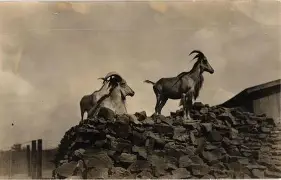
No period in Schitt family history remains more controversial than the events now collectively referred to as The Goat Era.
While official records remain incomplete, surviving tavern ledgers, property disputes, witness statements, and at least one bite report strongly suggest that goats held an unusually influential position within family affairs during this period.
Several branches of the family continue to deny the existence of a formal Goat Council. The Archives take no official position on the matter.
Witness: Ezekiel P. Schitt
Date: 1832
“I ain’t sayin’ the goats voted.
I’m merely sayin’ decisions was made,
and every goat seemed pleased with the outcome.”
1841 Property Survey
Owner:
Crockett O. Schitt
Livestock:
11 goats
Additional Goats:
7
Unexplained Goats:
3
Archive Note:
Several pages from this period appear to have
been eaten before preservation efforts began.
Experts disagree whether this should be
classified as deterioration or testimony.
A Note Regarding the Great Goat Incident of 1886
Curator’s Introduction
Among all surviving Schitt family records, none have generated more confusion than those relating to the Great Goat Era.
Much of what historians understand about this period survives only because of the meticulous journals, correspondence, and family registers kept up by Abigail Schitt, whose careful recordkeeping preserved events that might otherwise have disappeared into county folklore.
Abigail repeatedly cautioned later researchers against confusing the Goat Era with the Great Goat Incident of 1886. According to her notes:
“The Era made the Incident possible. It did not cause it.”
Subsequent historians have debated exactly what she meant. Think Broke never claimed ta figure that one out….. Most agree she knew considerably more than she ever committed to paper.
Now I realize some folks get themselves all twisted up over dates n’ things …… They’ll point at the title of this collection and holler,
“Crock! This here page says 1811 through 1847. Then why’s everybody keep jawin’ about the Great Goat Incident of 1886?”
Perfectly fair question. Perfectly wrong conclusion.
The Great Goat Incident of 1886 – Little Schitt’s Crossing — Historical Incident Reference
By 1886, the goats of Little Schitt’s Crossing had become entangled in an increasingly complicated arrangement of ownership, borrowing, breeding, and pasture rights. Family recollections describe altered identifying marks, extended borrowing arrangements, concealed offspring, and fences whose effectiveness was largely theoretical. For a time, these arrangements apparently satisfied the people involved.
The goats were less cooperative.
As the animals returned to familiar feeding grounds, breeding locations, herds, and former homes, discrepancies began to emerge between claimed ownership and observable behavior. By autumn, the goats had effectively rearranged themselves in a manner that exposed several longstanding disagreements. The incident did not establish legal ownership. Nor did it resolve every dispute.
It did, however, make certain explanations considerably more difficult to maintain.
A surviving observation attributed to Abigail Ruth Schitt summarizes the matter:
“The goats did not settle ownership. They settled several arguments.”
The Documentary Consequences
The incident’s archival legacy extends beyond livestock disputes.
Materials preserved in the Abigail Ruth Schitt Collection include damaged and incomplete documents associated with this period. Missing portions, irregular marks, and disputed causes of deterioration have complicated subsequent historical interpretation.
Goat involvement has been suggested in connection with some damaged records, although the Archives distinguish suspicion from proof.
Museum Finding: The Great Goat Incident of 1886 demonstrated that livestock could expose contradictions in human testimony without ever being qualified to give testimony themselves.
Curatorial Observation: A goat cannot testify. But it certainly can walk.
Visitors seeking the fuller historical account are directed to the existing Great Goat Incident records and the Abigail Ruth Schitt Collection.
The Great Goat Era refers to the period when goats first became deeply woven into everyday Schitt family life. Those thirty-six years produced an astonishing number of county reports, fence disputes, crop complaints, missing laundry, unexplained hoof prints, church disagreements, and several incidents that remain difficult to classify. By 1847, goats had become so thoroughly established in local life … that county officials stopped writing down every occurrence.
As stated above, by 1847, goats had become so established, ubiquitous if you ask me, Schitt life of every variety … … kinda like kin, but a goat! … YET – Unfortunately…
That did not mean the goats stopped. RECORDS ER’ RECORDS N’ GOATS ER’ GOATS!
The event historians now call The Great Goat Incident of 1886 occurred nearly forty years after the close of the Goat Era and is generally regarded as its single largest surviving consequence.
The archives contain extensive documentation regarding the 1886 incident. County officials continue to deny the goats’ involvement.
The goats have never commented er’ complained. Mrs. Abigail spent near forty years tryin’ ta keep folks from confusin’ the Era with the Incident.
Didn’t work. I’m still splainin’ it.
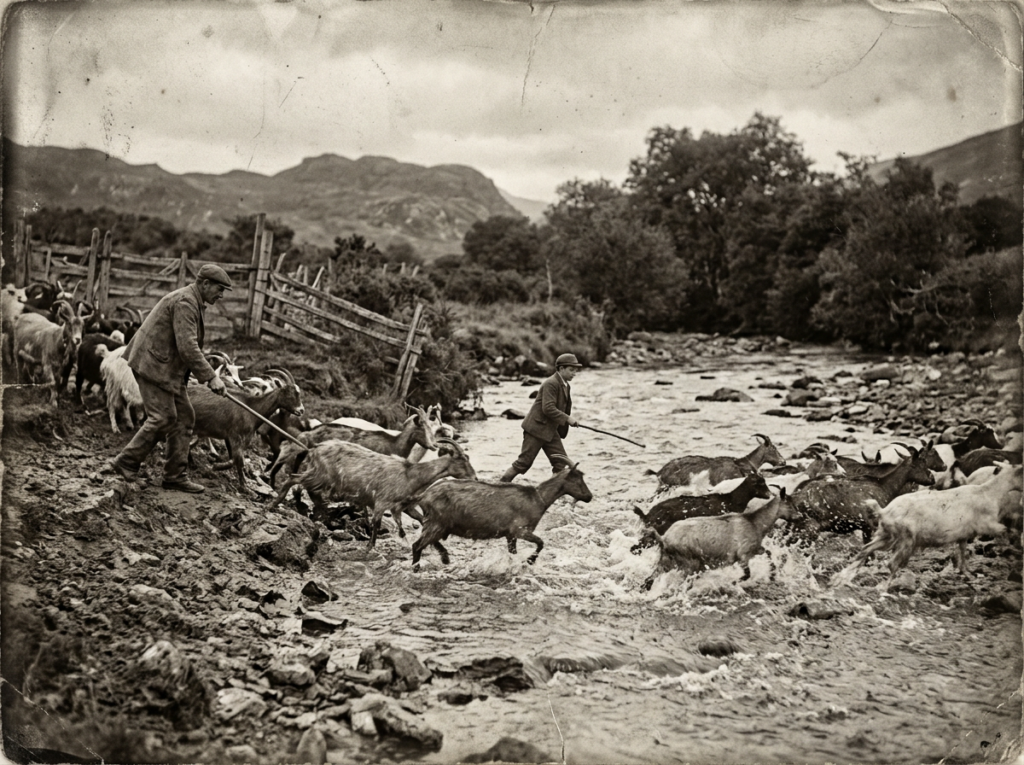
Goats being driven across the ford at Little Schitt’s Crossing, date unknown. Efforts to maintain an orderly crossing appear to have been only partially successful.